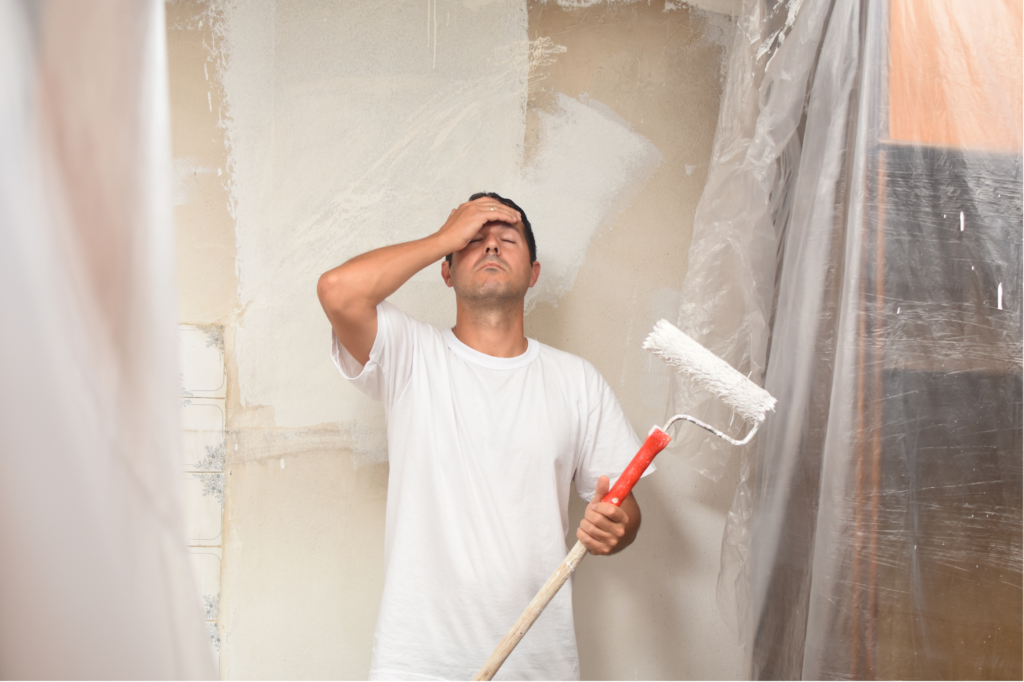
Painting looks straightforward. How hard can it be to roll paint onto a wall? For some jobs, honestly, not very. For others, it’s a bigger undertaking than it appears, and the difference between the two is worth understanding before you commit a weekend (or three) to it. Here’s an honest look at where DIY makes sense and where a professional pays for itself.
What DIY painting actually involves
The painting part is only a fraction of the job. A proper result also means moving and protecting furniture, filling and sanding, cleaning and priming surfaces, cutting in neat edges, applying even coats without lap marks, and cleaning up afterwards. For a single small room in good condition, that’s an achievable weekend project and a satisfying one. The trouble starts when the scope grows.
Where DIY tends to go wrong
- Underestimating the prep. Most disappointing paint jobs fail because of what happened (or didn’t) before the paint went on.
- Patchy coverage and visible lap marks from the wrong technique, cheap rollers or rushing between coats.
- Messy cutting-in around trims, ceilings and edges, the detail that separates a tidy job from an amateur one.
- Fixing mistakes costs more than doing it right. Stripping and redoing a botched job, or repairing paint that’s lifted because the surface wasn’t prepped, often ends up dearer than hiring a pro at the start.
What a professional brings
A good painter brings more than a steady hand:
- Proper preparation, done as a matter of course, because they know it’s what makes the finish last.
- Speed and efficiency. A job that takes you three weekends might take a team a few days, with a better result.
- The right products and tools for each surface, and the knowledge of which to use where.
- A clean, tidy, low-disruption process and someone accountable for the outcome.
- Access to heights safely. This matters in Wellington, where two-storey weatherboard homes, sloping sites and awkward access are common. Working at height is where DIY stops being about quality and starts being about safety.
How to weigh up cost versus value
DIY looks cheaper on paper, but factor in the true cost: quality paint and tools, your time, the likelihood of redoing bits, and the finish you’ll live with every day. For small, simple, ground-level jobs, DIY often wins. For whole houses, exteriors, detailed work, significant prep, or anything at height, a professional is usually the better value once everything’s counted.
Questions to ask before you hire
If you do bring someone in, a few questions sort the good from the rest:
- Are you the person doing the work, or is it subcontracted out?
- What does your preparation involve?
- Are you insured?
- Can I see examples of your work or talk to past customers?
Good painters are happy to answer all of these.
The honest bottom line
Some jobs are genuinely worth doing yourself, and we’d never tell you otherwise. But for the bigger or trickier ones, especially exteriors and anything at height, a professional saves you time, mess and the frustration of a result that isn’t quite right.
Silver Fern Painting is owner-operated by Andy Reeves, a qualified Master Painter with 30-plus years across Wellington. If you’re weighing up a project, see what we offer or get a free, no-obligation quote, even just to compare against doing it yourself.